
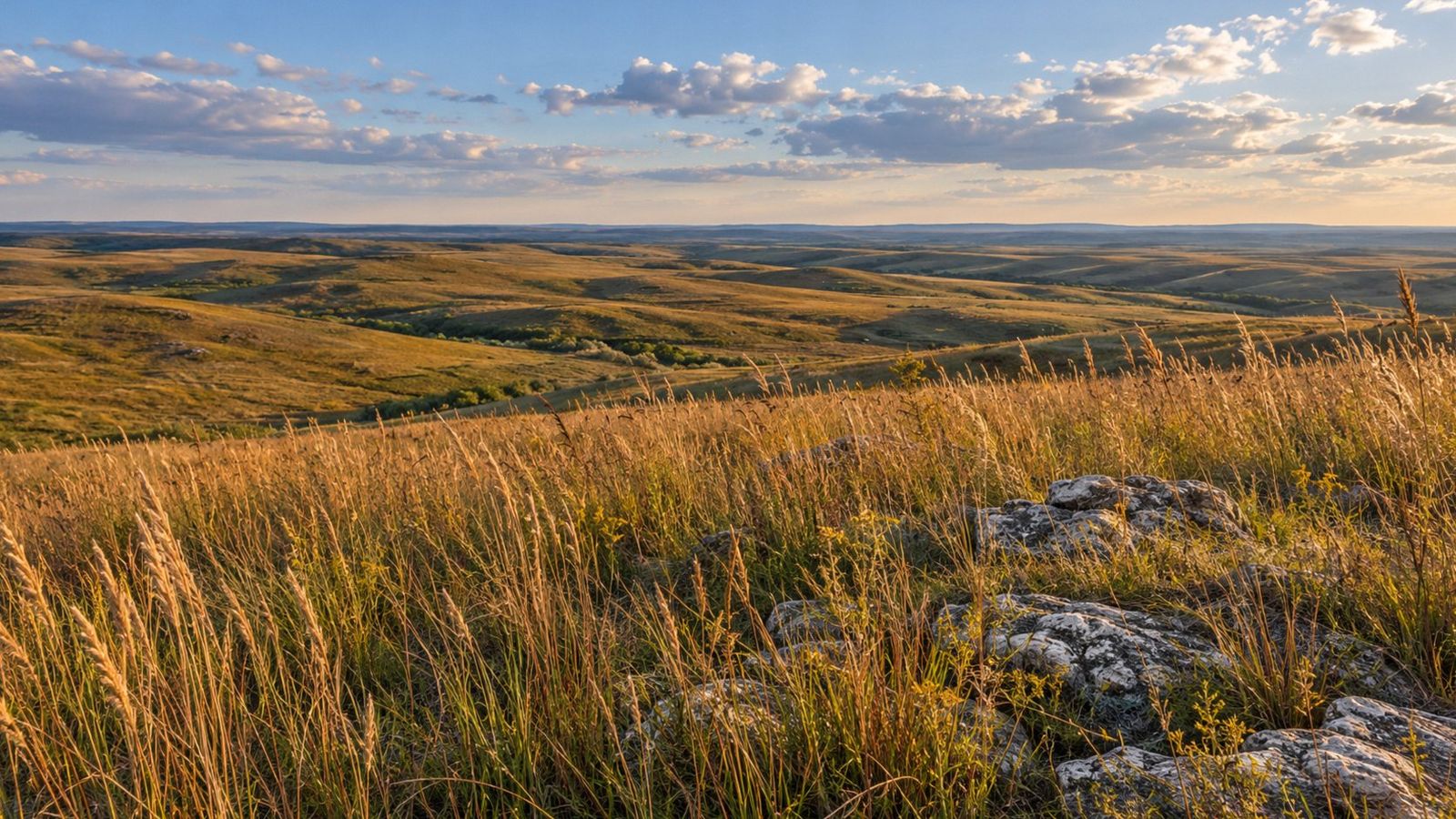
A walk through Kansas prairie can take you well beyond the view from the interstate. On foot, the hills reveal limestone, changing grasses, and a horizon that keeps opening up. Elsewhere in the state, a former school and a small rural community tell stories with consequences far beyond Kansas.
If you're looking for national parks in Kansas, these are the places worth understanding before you plan a trip. Start with the kind of visit you want: time outdoors, an afternoon of history, or a road trip combining both.
Does Kansas have any national parks?
Kansas has no park with the official designation National Park. It does have places within the National Park System, which includes preserves, historical parks, historic sites, and other designations. That distinction explains why some guides say Kansas has no national parks while others list several.
The five main destinations below are listed in the National Park Service guide to Kansas. National Historic Trails also cross the state, but they are spread-out routes with individual stops rather than single parks you enter through a main gate.
| Destination | Location | Main reason to visit | Suggested visit |
|---|---|---|---|
| Tallgrass Prairie National Preserve | Near Strong City | Prairie walks, historic ranch buildings, and bison viewing | Half day or longer |
| Brown v. Board of Education National Historical Park | Topeka | The people and events behind school desegregation | 1 to 2 hours |
| Fort Scott National Historic Site | Fort Scott, southeastern Kansas | Military buildings, Bleeding Kansas, and Civil War history | 2 to 3 hours |
| Fort Larned National Historic Site | Near Larned, central Kansas | A preserved army post on the Santa Fe Trail | 2 to 3 hours |
| Nicodemus National Historic Site | Nicodemus, northwestern Kansas | Black migration, community building, and settlement | 1 to 2 hours |
These are suggested planning allowances, not fixed tour lengths. Travel between destinations is additional.
Tallgrass Prairie: leave time to get beyond the ranch
Tallgrass Prairie National Preserve is the strongest starting point if your idea of a park visit involves walking through a landscape. Near Strong City in the Flint Hills, it combines rolling prairie with the historic Spring Hill Ranch, a limestone barn, and the Lower Fox Creek schoolhouse.
Begin around the visitor center and ranch buildings, then choose a trail that fits the weather and your energy. The 1.75-mile Southwind Nature Trail gives you hills, prairie vegetation, and overlooks without committing to a long backcountry outing. The Bottomland Nature Trail offers shorter loops and gentler slopes, although surface conditions matter for mobility access.
Want a longer prairie walk?
This is a substantial walk rather than a quick viewpoint stop. Check the NPS trail descriptions and choose an alternative if wildlife blocks your route.
Bison live within designated pastures, so seeing them depends on where the herd is that day. Keep at least 125 yards away when hiking, as directed by the preserve's bison safety guidance. Turn back if you cannot maintain a safe distance. A trail through a pasture is not a promise of a close wildlife encounter.
Late September and October are worth considering if you want to see the grasses near their full height. Spring offers fresh growth, but the grass is still short, and prescribed burns can affect access. Summer brings flowers along with heat and exposed walking.
Allow half a day for the ranch and a shorter trail, or more for a backcountry hike. Admission is free, and ordinary visits do not require a reservation. Trails generally remain open around the clock, subject to closures, but buildings keep separate hours. Camping and overnight parking are not allowed.
Brown v. Board of Education: step inside the story of school desegregation
Brown v. Board of Education National Historical Park makes a different kind of stop. Its Topeka visitor center occupies former Monroe Elementary School, one of the city's segregated schools for Black children. The exhibits connect the 1954 Supreme Court decision with the families and communities who challenged segregation.
Spend time with the galleries and films rather than treating the building as a photo stop. The visit is largely indoors, making it a useful option when prairie weather turns uncomfortable. Allow one to two hours, depending on how much you read and watch.
Check the day of the week before driving to Topeka. At the time of checking, the visitor center opens Tuesday through Saturday, with holiday exceptions. Admission and parking are free. The park's visitor information covers hours, accessibility, and entry restrictions.
Fort Scott: look beyond the parade ground
Fort Scott National Historic Site is worth choosing for the way its buildings connect several periods of Kansas history. Established in 1842, the post later became part of the story of Bleeding Kansas, the violent conflict over slavery before the Civil War. During the war, Fort Scott served as a Union military base.
Start at the visitor center for an introduction, then explore the buildings and grounds on a self-guided visit. Interior exhibits help explain what happened here, so a walk around the outside gives only part of the picture. A short prairie trail adds an outdoor break.
- For a first visit: allow two to three hours for orientation, exhibits, and the grounds.
- For more activity: look for a scheduled living-history event or ranger program.
- Before setting off: confirm building hours and event dates. Demonstrations are not an everyday feature.
Admission is free. Its southeastern location makes Fort Scott a separate excursion from Topeka or the Flint Hills rather than a quick stop between the two.
Fort Larned: explore a Santa Fe Trail army post
Fort Larned National Historic Site, west of the town of Larned, suits visitors interested in the Santa Fe Trail and military life on the Plains. Nine original buildings survive, alongside a reconstructed building, giving you more to explore than foundations and historical markers.
Use the visitor information and self-guided tour to understand the buildings' different roles. The post's history includes soldiers, trade, and conflict with Plains Native nations. Reading the interpretation helps place the military setting within that wider history.
Allow two to three hours for a first visit, longer during a special event. Much of the experience involves moving between buildings, so bring layers in cold weather and water in summer. Admission is free; check operating hours before building a route around an early arrival or late stop.
Nicodemus: a small community with a lasting story
Nicodemus National Historic Site tells the story of African Americans who moved west after the Civil War to build lives and communities on the Great Plains. Founded in 1877, Nicodemus remains a place to understand Black settlement through the history of a particular town.
Begin at the Township Hall visitor center for exhibits and films, then explore the historic buildings. The site includes five historic structures, but that does not mean all five interiors are open. Check current access rather than assuming a full building tour will be available.
A useful stop, even with limited time
The NPS visit planner suggests options for a 30-minute visit and for one to two hours. With more time, add a self-guided walk and ask whether a ranger-led walk is available.
Admission is free. Nicodemus sits along U.S. Highway 24 in northwestern Kansas, so include it when your route takes you through that region. Avoid treating it as a short detour from the eastern sites.
What about the National Historic Trails in Kansas?
The Oregon, California, Santa Fe, Pony Express, and Lewis and Clark National Historic Trails have connections to Kansas. Visiting them usually means choosing specific historic places, interpretive stops, or surviving trail traces.
They are not five continuous hiking paths across the state. Access and ownership vary between stops. Choose a place that fits your route, confirm public access, and use the relevant trail map rather than assuming a historic route is open for walking everywhere.
How to plan a Kansas park trip without rushing
For a first weekend, focus on Topeka and Tallgrass Prairie. Spend one day at Brown v. Board of Education and another in the Flint Hills. This suggested pairing gives you both history and outdoor time without trying to cross the whole state. Arrange the Topeka visit around its opening days.
Fort Scott works as a southeastern trip, while Fort Larned and Nicodemus can become stops on a longer journey through central and western Kansas. If you want all five, build a multi-day route around your starting point and overnight stops. Count the drives separately from the visiting allowances in the table.
There is no entrance charge at the five destinations covered here, so you do not need an America the Beautiful pass just to enter them. Accommodation, meals, fuel, and any separately booked activities still belong in your budget.
For prairie walking, check the forecast and alerts before choosing a long route. Carry water, sun protection, insect repellent, and a map you can use without a signal. Open grassland offers little shelter from heat, wind, or storms.
Choose the Kansas experience you want most
Start with Tallgrass Prairie if you want a landscape to explore on foot. Choose Brown v. Board of Education for civil rights history, Nicodemus for the story of Black settlement, or one of the forts for a closer look at the military posts and conflicts that shaped the Plains.
Kansas rewards a route with time to walk, read, and ask questions. Two well-chosen stops will give you more than a rushed attempt to collect every site in a weekend.